Plants for your wildlife pond
Oxygenators and Floaters
Pond plants are essential to achieve a correct water balance and provide surface cover in your garden pond. Without them your water will probably resemble pea soup, as algae will grow prolifically. Plant foliage absorbs carbon dioxide and minerals from the water which 'starves' the algae. About half of the water surface should be covered with foliage to achieve this balance.
Pond plants fall into four basic groups. Each is important to the health of your pond. The groups are oxygenators, floaters, marginals and deep water aquatics.
Oxygenators are very important for keeping the water clear. Their roots and stems are submerged and usually the leaves are submerged as well. They are often bought in bunches. You will need one bunch for each 3 sq. ft. of surface area. Most oxygenators do not flower, but two exceptions are water violet and water buttercup. |
|
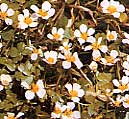
Water milfoil is effective for a small pond. Willow moss is evergreen, slow growing and effective. Hornwort and 'curly pond weed (elodea crispa) are also effective.
Floaters are just that. You simply drop them into the pond. Their roots are submerged and their leaves and stems float either on or just below the surface. They provide surface cover. Many of them sink and overwinter at the bottom of your pond. Other floaters include frog-bit, water lettuce and water soldier. Fairy moss and duck weed are also floaters, but can be invasive and are best avoided. Once you have duck weed established in your pond, you will never get rid of it! |
Construction Pages
Page 1 Some considerations |
Page 2 Wildlife or Fish? |
Page 3 Pond Materials |
Page 4 Get Digging! |
Page 5 Pond Liner |
Page 6 Finishing Touches |
You are on page 7 of 8 |
Page 8 Plants - Marginals |
Frogs, frogspawn & tadpoles - page [1]
[2] Main
Pond Page
Main
Pond Page