
On This Day - 18th April
1689 The death of Lord Chief Justice George Jeffreys (see 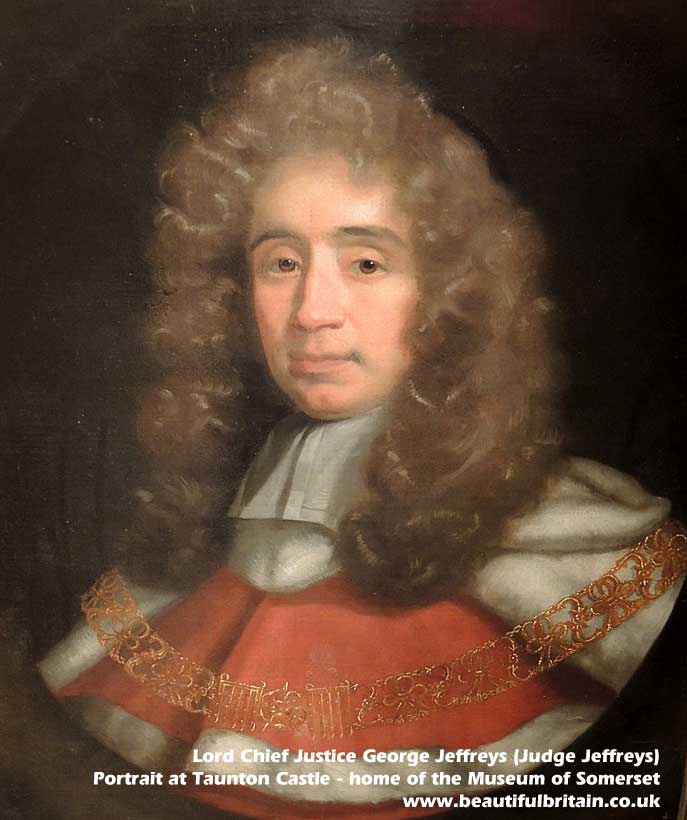 picture), known as the Hanging Judge. He led the Taunton Assize trials that came in the aftermath of the Battle of Sedgemoor, the battle that ended the Monmouth Rebellion in England. The trials took place in the Great Hall of Taunton Castle (now the home of the Museum of Somerset - see
 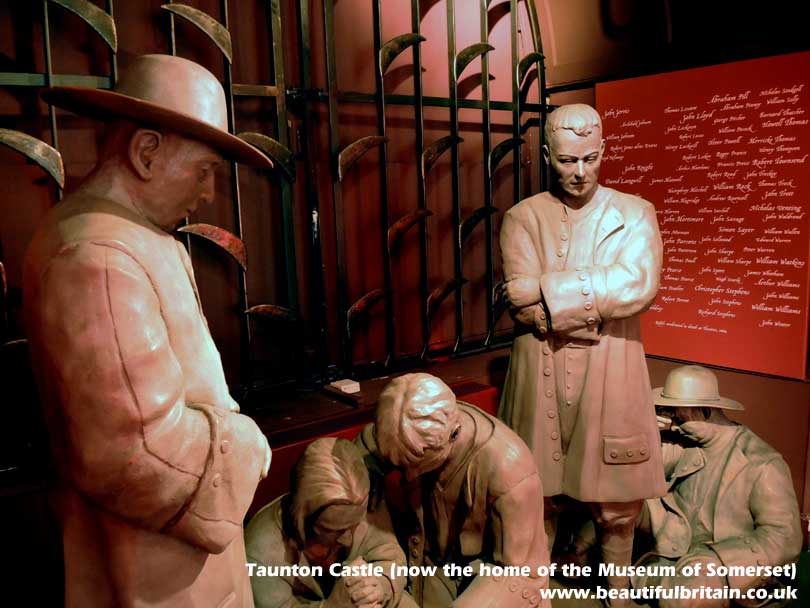 picture). Of more than 500 prisoners brought before the court, 144 were hanged and their remains displayed around the county.
1740 The birth of Sir Francis Baring, English merchant banker. Barings was the oldest merchant bank in London until it collapsed in 1995 after one of the bank's employees, Nick Leeson, lost £827 million on speculative investing.
1775At the start of the War of American Independence, US patriots Paul Revere and William Dawes left Boston, bound for Concord, to warn people that British troops were advancing. After Revere's and Dawes's arrest en route, the ride to Concord was completed by compatriot rider and escapee Dr. Samuel Prescott.
1881The Natural History Museum in London was opened.
1899The St. Andrew's Ambulance Association was granted a Royal Charter by Queen Victoria. The Association seeks to preserve the lives of people in Scotland by the provision of education and emergency first aid at events throughout Scotland.
1912The Cunard liner RMS Carpathia brought 705 survivors to New York from the RMS Titanic that had sunk on on 15th April 1912 after colliding with an iceberg during her maiden voyage from Southampton. Titanic's engineers, who battled below decks to try and keep Titanic afloat are commemorated on this monument (see  picture) in Southampton.
1946The birth of Hayley Mills, English actress, daughter of actor John Mills and sister of actress Juliet Mills.
1949The Republic of Ireland Act came into force as Eire (Southern Ireland)
became a Republic and left the British Commonwealth.
1949The first 'Bob-a-Job week' began when 440,000 British Scouts started
a nationwide campaign to raise the £22,000 needed to cover the deficits
of the Scout movement. In the first year £60,000 was raised. The variety
of jobs undertaken included a 13 year old who spent four hours cleaning the
silver at 10 Downing Street.
1960At least 60,000 demonstrators gathered in Trafalgar Square to mark the
end of the Aldermaston to London 'ban the bomb' march.
1968London Bridge was sold for £1m to American oil tycoon Robert McCullough.
He decided to knock it down, brick by brick, and have it re-built at Lake Havasu
in the United States.
1980Rhodesia became Zimbabwe at midnight and independent from Britain.
Canaan Banana was the President and Robert Mugabe the Prime Minister.
1986Guinness, the giant brewery business, won their battle to take over the
equally large spirits combine, the Distillers Group. The manner of the takeover
was later investigated by the Director of Public Prosecutions and led to arrests
of top financial figures including the Guinness chief executive, James Saunders.
1988In the House of Commons, the 16th-century symbol of the Speaker’s
authority, the Mace, was damaged by Ron Brown, Labour MP for Leith, when he
flung it to the floor during a debate. It was described by his own supporters
as ‘a childish stunt’ and led to his 20 day suspension.
1994West Indian batsman Brian Lara broke the record for the highest individual
score in Test Cricket when he scored 375 against England in Antigua.
2013The death of Hillsborough justice campaigner Anne Williams, at the age of 60. She fought relentlessly for the new inquest into her son Kevin's death in the 1989 football tragedy. He was one of 96 Liverpool fans who died as a result of a crush during an FA Cup match at the Sheffield stadium.