
On This Day - 12th April
1567 The Earl of Bothwell was found not guilty of the murder of Lord Darnley,
the husband of Mary Queen of Scots. Bothwell and Mary then married.
The Earl of Bothwell was found not guilty of the murder of Lord Darnley,
the husband of Mary Queen of Scots. Bothwell and Mary then married.
1606The Union Flag became the official flag of Britain. It combined the flags
of St. George (England) and St. Andrew (Scotland). As Wales was not a Kingdom
but a Principality it could not be included on the flag. In 1801 the cross
of St. Patrick (Ireland) was incorporated to create the flag that has been
flown ever since.
1709The first edition of the Tatler Magazine was published 'On This Day'.
1831Soldiers marching on the Broughton Suspension Bridge in Manchester caused it to collapse, reportedly owing to a mechanical resonance induced by troops marching over the bridge in step. Forty of the soldiers were thrown into the river. As a result of the incident the British Military issued an order that troops should 'break step' when crossing a bridge.
1838English settlers in South Africa defeated the Zulus at the Battle of
Tugela. The settlers had guns whereas the Zulus only had spears.
1902In South Africa, Boer leaders met the British commander Lord Kitchener
to discuss peace proposals to end the Boer War.
1927The British Cabinet came out in favour of voting rights for women.
1935The first flight of the Bristol Blenheim, a British light bomber aircraft designed and built by the Bristol Aeroplane Company that was used extensively in the early days of the Second World War. BAC went on to become a founding component of the nationalised British Aerospace, now BAE Systems.
1937British engineer, Frank Whittle, tested the first jet engine at the Thomson-Houston factory in Rugby. The first
jet flight was achieved by the German Heinkel, but it was Whittle’s engine
that was used as the prototype. Whittle was born at Earlsdon, a suburb of Coventry This statue of him (see  picture) is outside Coventry's Transport Museum.
1939The birth of Sir Alan Ayckbourn, prolific English playwright. His plays have been translated into over 35 languages and are performed on stage and television throughout the world. Ten of them have been staged on Broadway, attracting two Tony nominations, and one Tony award. He was the Artistic Director of the Stephen Joseph Theatre, Scarborough (see 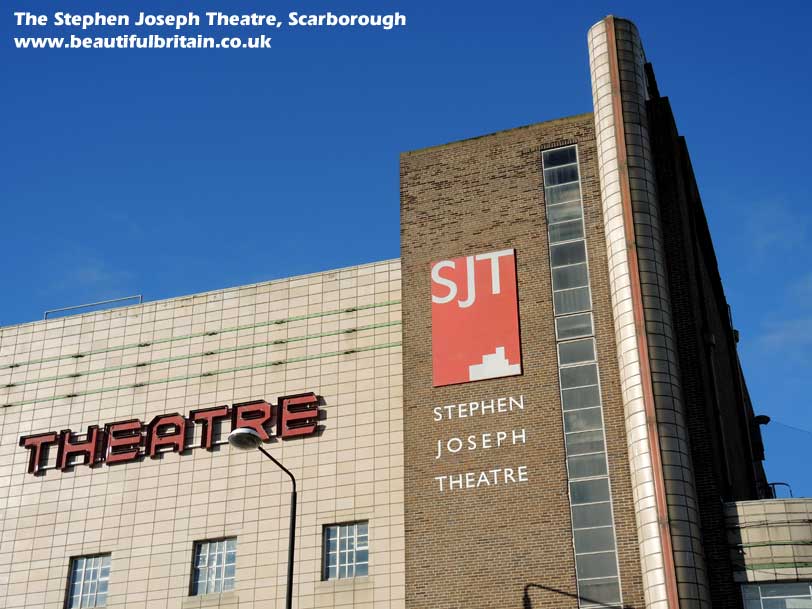 picture), where the majority of his work has been premiered.
1941Bobby Moore, English footballer was born. He captained West Ham for more than ten years and was captain of the England team that won the 1966 World Cup. He is widely regarded as one of the all-time greats of world football, and was cited by Pelé as the greatest defender that he had ever played against.
1954American, Bill Haley recorded 'Rock Around The Clock'. It was first record to sell
a million copies in Britain.
1984Arthur Scargill, leader of the miners' union the NUM, would not allow
a national ballot to take place on whether to stop the miners' strike.
1989Andrew Lloyd Webber’s 'Cats' was performed for the 3,358th time at the New
London Theatre, Drury Lane, making it Britain’s longest running musical.
Steven Wain who played one of the cats, was the only member of the original
cast still in the show after eight years. Seats were booked to the end of 1999.
2000The Queen presented the Royal Ulster Constabulary (RUC) with the George
Cross, the highest civilian award for bravery.
2013Five members of the same family, including a baby, were killed in a crash on the A18 near Grimsby. A nationwide survey conducted by the Road Safety Foundation in 2010 deemed the Grimsby section the UK's highest-risk stretch of road for car drivers.
2020 The death (aged 90) of the British motor racing legend Sir Stirling Moss. Described as ‘A mighty racer and a true gentleman’, Stirling Moss was widely regarded as one of the greatest Formula 1 drivers of all time, even though he never won the World Championship. He won 16 of the 66 Formula 1 races he competed in (between 1951 and 1961) and in 1955, at Aintree, he became the first British driver to win a home grand prix.