
On This Day - 4th January
871 The Battle of Reading took place, in the county of Berkshire. It followed an
invasion of the then kingdom of Wessex by an army of Danes. The Saxon forces retreated, allowing the Danes to
continue their advance into Wessex. Much of King Alfred's 28-year reign was taken up with this Danish conflict.
The Battle of Reading took place, in the county of Berkshire. It followed an
invasion of the then kingdom of Wessex by an army of Danes. The Saxon forces retreated, allowing the Danes to
continue their advance into Wessex. Much of King Alfred's 28-year reign was taken up with this Danish conflict.
1642Under the orders of King Charles I, armed soldiers entered Parliament. The
English Civil War started shortly afterwards.
1813Birth of Sir Isaac Pitman, English inventor of the first major shorthand
system. Pitman founded a company called Sir Isaac Pitman and Sons, which became one of the world's leading
educational publishers and training businesses. In 1837-38 he became a teetotaller and vegetarian, practices to
which he attributed his health and his ability to work long hours.
1890The Daily Graphic was launched; the first daily illustrated paper. It merged
with the Daily Sketch in 1926. .
1932Gandhi was arrested and his National Congress of India declared illegal by
the British administration.The warrant for Gandhi's arrest merely said that he was being arrested 'for good and
sufficient reasons.'
1938Bertram Mills’ Circus became the first circus to be shown on
television. This was also the first time that a paying audience for any event had been televised, and audience
members were informed that they could request seats out of range of the cameras. Originally from Paddington,
London, his circus became famous in Britain for its Christmas shows at Olympia in West London and his troupe were
the last to perform with live animals on the Drury Lane Theatre stage.
1957A dissatisfied plastic surgeon patient was sentenced in London to ten
years’ imprisonment, after he had threatened his surgeon with a gun, complaining that his nose was too
short.
1967Donald Campbell, 46 year old son of Sir Malcolm Campbell, died in his
attempt to break his own world water speed record on Coniston Water in the Lake District. This plaque (see - 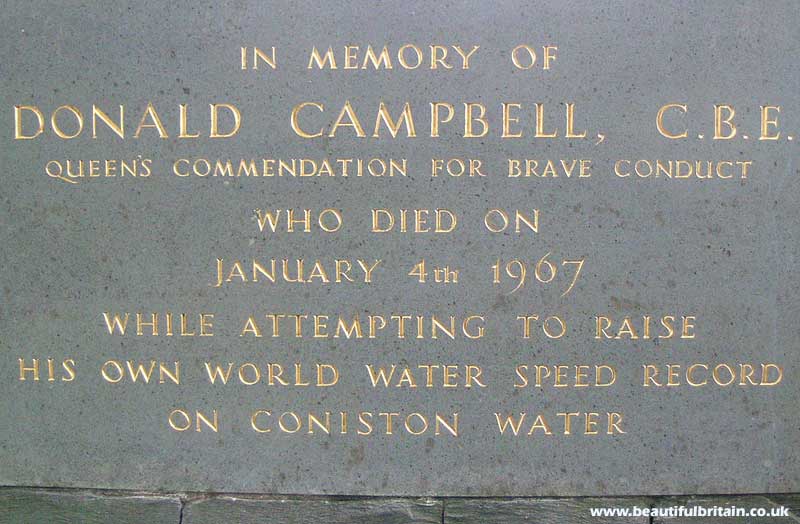 picture) is in the village of Coniston. His boat, Bluebird K7, somersaulted at
high speed, and Campbell died instantly and is buried in Coniston graveyard (see -
picture) is in the village of Coniston. His boat, Bluebird K7, somersaulted at
high speed, and Campbell died instantly and is buried in Coniston graveyard (see - 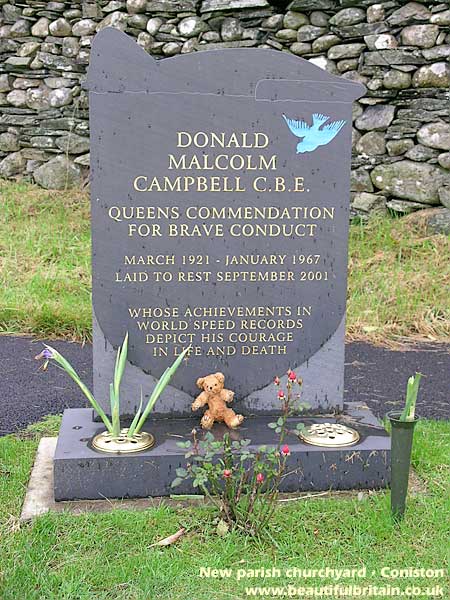 picture). The wreckage of Campbell's craft was recovered by the Bluebird Project between
October 2000, when the first sections were raised, and June 2001 when Campbell's body was recovered. It is intended
to return a rebuilt Bluebird to Coniston before permanently housing her at the nearly Ruskin museum.
picture). The wreckage of Campbell's craft was recovered by the Bluebird Project between
October 2000, when the first sections were raised, and June 2001 when Campbell's body was recovered. It is intended
to return a rebuilt Bluebird to Coniston before permanently housing her at the nearly Ruskin museum.
1972Rose Heilbron became Britain’s first woman judge at the Old Bailey.
Her career included many 'firsts' for a woman - she was the first woman to win a scholarship to Gray's Inn, the
first woman to be appointed King's Counsel in England, the first to lead in a murder case, the first woman
Recorder, the first woman judge to sit at the Old Bailey and the first woman Treasurer of Gray's Inn.
1998Loyalist prisoners in the Maze Prison, Northern Ireland, voted to withdraw
support for the Ulster Peace Process. They claimed that too many concessions had been made to Republicans.
2000Catherine Hartley and Fiona Thornewill, the first British women to walk
across Antarctica to the South Pole arrived safely, more than two months after starting their record-breaking
journey.
2014Richard Parks, a former Welsh rugby player turned adventurer claimed a
record for the fastest solo, unsupported and unassisted journey to the South Pole by a Briton. The 715 mile journey
took 29 days, 19 hours and 24 minutes. In 2011, Parks achieved his world-record-breaking dream to reach seven
summits and three poles in seven months in his 737 Challenge, aiming to raise £1m for Marie Curie Cancer
Care.
2017 The last ABC cinema closed its doors. The Bournemouth cinema (which opened in June 1937) had only kept its name by a quirk of positioning in the town. It closed with a final screening of 'Back to the Future', which was chosen by its audience.
2021 Brian Pinker, aged 82 and from Oxford, became the first person in the world to be given the Oxford-AstraZeneca vaccine, at Oxford's Churchill Hospital.
2021 Scottish MP Margaret Ferrier was arrested and charged by police after she admitted using public transport in September while infected with Covid-19. She admitted travelling to London and attending debates in the Commons despite taking a Covid-19 test. After being told her test was positive, Ferrier then travelled home by train from London via Glasgow, and later acknowledged visiting several businesses in her Rutherglen constituency on the day she took the test.