
On This Day - 8th July
975 The death of Edgar the Peaceful or the Peaceable who was King of England from 959 to 975. He was the younger son of King Edmund I and his Queen, Ælfgifu of Shaftesbury.
1822 The death of Percy Shelley,
English poet. He drowned in Italy while sailing his small schooner Ariel to
his home on the Gulf of Spezia. Most papers reported Shelley’s death as an accident, but others speculated that he might have been murdered by an enemy who detested his political beliefs. In September 1812 Shelley, pursued by debtors and authorities who wished to question the poet about his radical political activities had fled to Tremadog and lived at at Tan-yr-allt (see
The death of Percy Shelley,
English poet. He drowned in Italy while sailing his small schooner Ariel to
his home on the Gulf of Spezia. Most papers reported Shelley’s death as an accident, but others speculated that he might have been murdered by an enemy who detested his political beliefs. In September 1812 Shelley, pursued by debtors and authorities who wished to question the poet about his radical political activities had fled to Tremadog and lived at at Tan-yr-allt (see  picture), the former home of William Madocks, the designer and builder of most of Tremadog. When Shelley left Tan-yr-allt, his rent was unpaid and without contributing to the fund to support the house owner, William Madocks.
1836The birth of Joseph
Chamberlain, self-made businessman, influential British politician,
statesman and the father of former Prime Minister Neville Chamberlain. He
resigned from Gladstone's Third Government in 1886 in opposition to Irish
Home Rule and as Secretary of State for the Colonies he presided over the
Second Boer War. Despite never becoming Prime Minister, he is regarded as
one of the most important British politicians of the late 19th and early
20th centuries.
1884The National Society for the
Prevention of Cruelty to Children (NSPCC) was founded in London.
1918National Savings stamps were
introduced in Britain.
1941Twenty B-17s flew on their
first mission with the RAF over Wilhelmshaven, Germany.
1961For the first time since 1941,
Britain provided both women finalists for the Wimbledon Ladies' singles
title - Christine Truman and Angela Mortimer
1965Ronald Biggs, who was serving a
30-year prison sentence for his part in the Great Train Robbery, escaped
from Wandsworth prison.
1967The death of Vivien Leigh,
English film actress whose films included Gone With The Wind.
1985Britain lifted its trade ban
with Argentina after the Falklands crisis ended.
1986British Steel made a profit for
the first time in 17 years.
1988A London double-decker bus
parked in Battersea, was put on sale for £40,000. It had been
converted into a luxury home to overcome rising property prices in the
capital.
1996Four young children and four
adults were attacked by a man with a machete at St Luke's Infants' School
in Blakenhall, Wolverhampton. Teacher Lisa Potts's arm was almost severed
in the attack and four children were injured. In 1997, Queen Elizabeth
presented her with the George Medal for her heroism in saving the
children's lives. Her attacker, Horrett Campbell, was sent indefinitely to
a secure mental hospital.
1996A patent was filed by two
British scientists to use genetically engineered mosquitoes to immunize
their victims against malaria by transferring a protein in their
saliva.
2000J. K. Rowling's fourth Harry
Potter book, Harry Potter and the Goblet of Fire went on sale, breaking all
publishing records.
2005The G8 summit in Gleneagles
ended with a deal to boost aid for developing countries by almost £28
billion.
2006The death of the actor and
voice artist Peter Hawkins. He voiced Bill and Ben the Flower Pot Men, Big
Ears & Mr. Plod from The Adventures of Noddy, all the voices for the
animated series Captain Pugwash, The Adventures of Tintin and many more. He
also voiced several characters on Doctor Who in the show's early years,
most notably the Daleks and the Cybermen. During the 1960s, 70s and 80s
Hawkins was one of the most sought after voiceovers for television and
radio.
2016 The opening of the Dickens Bar & Inn, in Scarborough, (see 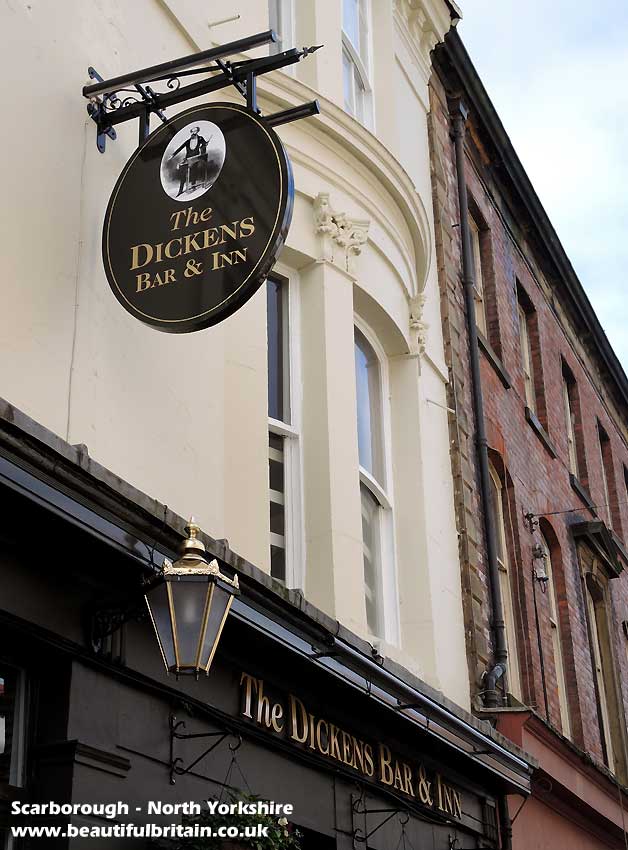 picture) originally named Pickwick Inn after Dickens’ first novel, The Pickwick Papers. The pub is located on the corner of Huntriss Row where Dickens gave readings at the Assembly Rooms in 1858. The author had a number of literary links to Scarborough and the surrounding areas, including Filey and Malton.