
On This Day - 15th July
971 According to the legend of St.
Swithin, if it rains today, it will be the start of forty days of rain. St
Swithin was bishop of Winchester Cathedral (see
According to the legend of St.
Swithin, if it rains today, it will be the start of forty days of rain. St
Swithin was bishop of Winchester Cathedral (see  picture) and asked to
be buried outside it so that he would be exposed to ‘the feet of
passers-by and the drops falling from above’.
picture) and asked to
be buried outside it so that he would be exposed to ‘the feet of
passers-by and the drops falling from above’.
1207England's King John expelled
Canterbury monks for supporting the Archbishop of Canterbury Stephen
Langton. Langton was a central figure in the dispute between King John and
Pope Innocent III, which was a contributing factor to the crisis which led
to the issuing of Magna Carta in 1215.
1381John Ball, a leader in the
Peasants' Revolt, was hanged, drawn and quartered in the presence of King
Richard II. The revolt later came to be seen as a mark of the beginning of
the end of serfdom in medieval England.
1573The birth of the architect
Inigo Jones, He left his mark on London by designing the Banqueting House,
Whitehall and Covent Garden square which became a model for future
developments in the West End.
1685Charles II's illegitimate son
(the Duke of Monmouth) was executed for rebelling against James II. His
head was then put back on his shoulders so that his portrait could be
painted.
1815French Emperor Napoleon
Bonaparte surrendered to Captain Maitland aboard the English ship
Bellerophon, at Rochefort, before being sent into exile on the island of St
Helena.
1857200 British men, women and
children were chopped up by local butchers and thrown down a well at
Cawnpore, as the Indian Mutiny continued.
1858The birth of the British
suffragette leader Emmeline Pankhurst. Emmeline and her daughters Christabel and Sylvia lived for 10 years at this house (see  picture) on 62 Nelson Street, Manchester. It was the birthplace of the Suffragette movement and is now the Pankhurst Centre (see plaque -
 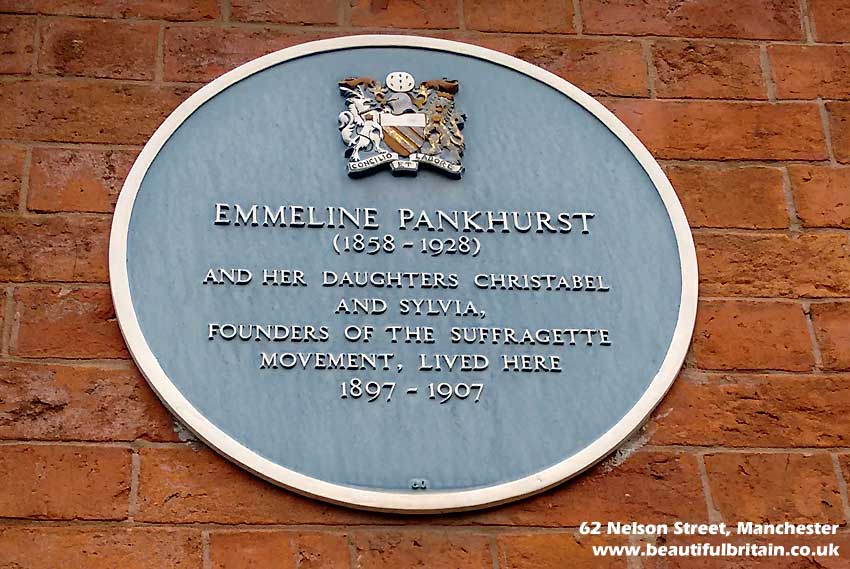 picture)
1865The birth of Alfred (Charles
William) Harmsworth, 1st Viscount Northcliffe. Northcliffe introduced the
first tabloid newspaper, the Daily Mail, followed later by the Daily
Mirror. He also took over The Times in 1908, and improved its declining
sales.
1912National Insurance payments
began in Britain.
1948Alcoholics Anonymous, in
existence in the USA since 1935, was founded in London.
1953Murderer John Christie,
responsible for the deaths of at least six women in his home at 10,
Rillington Place, London, was hanged.
1966A West Indian, refused a job at
Euston Station was later employed there after managers overturned a ban on
black workers.
1977The government announced a 10%
pay restriction on wages to help curb inflation.
1996Prince Charles and Princess
Diana were granted a decree nisi. Princess Diana could no longer be
addressed as Her Royal Highness but was to be known as Diana, Princess of
Wales.
2000Two men caught on camera for
dangerous driving escaped prosecution in a landmark case, as it had
violated their human rights.
2014Former Tory leader William
Hague resigned, thus ending his political career which started at the aged
of 16 when he took the 1977 Conservative Party conference by storm.
2015The planned 'free vote' by MPs
on weakening the hunting ban was dropped after the SNP decided to vote
against the changes, even though they only affect England and Wales. Under
the proposals, hunters in England and Wales would have been able to use a
pack of dogs to flush out foxes before shooting them. There is currently a
limit of two dogs.