
On This Day - 17th July
924 The death of Edward the Elder, King of the Anglo-Saxons. He was largely ignored by modern historians until the 1990s, when historian Nick Higham described him as 'perhaps the most neglected of English kings'. Edward's reputation rose in the late twentieth century, and he is now seen as destroying the power of the Vikings in southern England, and laying the foundations for a south-centred united English kingdom.
1453 In the last battle of the
Hundred Years' War ( the Battle of Castillon) the French, under Jean
Bureau, defeated the English, under the Earl of Shrewsbury, who was killed
in the battle.
In the last battle of the
Hundred Years' War ( the Battle of Castillon) the French, under Jean
Bureau, defeated the English, under the Earl of Shrewsbury, who was killed
in the battle.
1674The birth of Isaac Watts,
English hymn writer. He was a prolific and popular hymn writer and is
credited with some 650 hymns. Many of his hymns remain in use today
including Joy to the World, O God, Our Help in Ages Past and When I Survey
the Wondrous Cross.
1717King George I sailed down the
River Thames for a concert, in a barge with 50 musicians. It was the
premiere of Frideric Handel's Water Music which George I was said to have
enjoyed so much that he made the exhausted musicians play the three suites
three times over the course of the outing.
1761The official opening of the
Bridgewater canal, built to transport the Duke of Bridgewater's coal from
his mine at Worsley, near Manchester.
1841The first issue of the humorous
magazine Punch was published in London. It ceased publication in 1992 but
was re-launched in 1996.
1917World War 1: The British Royal
Family, in a proclamation issued by George V, adopted the name of the House
of Windsor in place of their German family name of Saxe-Coburg-Gotha due to
the anti-German sentiment at the time.
1918The RMS Carpathia, the ship
that rescued the 705 survivors from the RMS Titanic, was sunk off Ireland
by the German SM U-55, with the loss of 5 lives.
1923The birth of John Cooper. He
developed the British Motor Corporation Mini Cooper, adored by rally racers
and ordinary drivers.
1960The Beatles began a three-month
engagement at The Indra Club in Hamburg, Germany, their first appearance
outside Britain.
1964British speed pioneer Sir
Donald Campbell set a new land speed world record of 403.10 mph in his car,
Bluebird. In July 2014, to coincide with the 50th anniversary of the
achievement, unseen family video footage of Donald Campbell breaking both
the land and water speed records in 1964 was restored. You can see the video link here, on the BBC website.
1974An explosion in the Tower of
London left one person dead and 41 injured. The incident happened without
the coded warning typical of the IRA.
1981The Humber Estuary Bridge (see 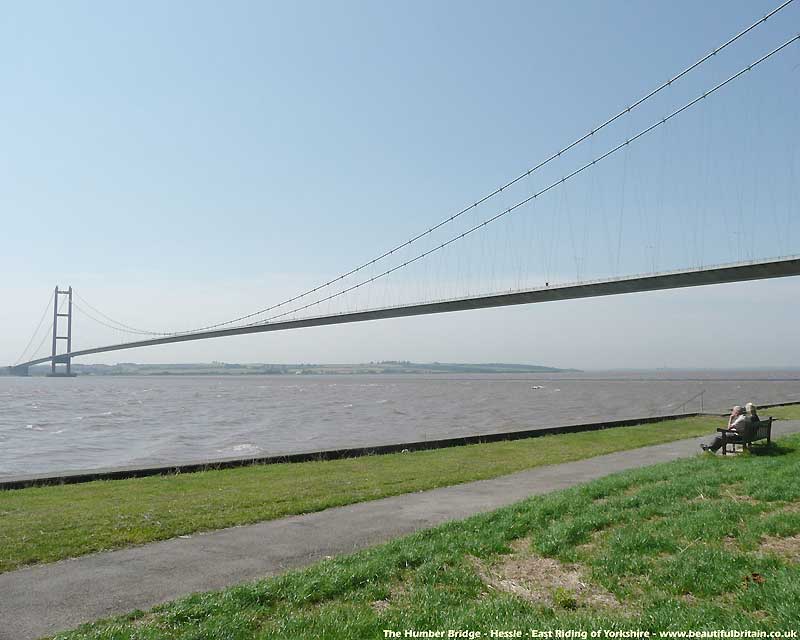 picture of the Humber Bridge) was officially opened by the Queen. For 16
years after its construction it was the world's longest single-span
structure.
picture of the Humber Bridge) was officially opened by the Queen. For 16
years after its construction it was the world's longest single-span
structure.
1987Former Guinness director Thomas
Ward was ordered to repay £5.2m to the brewing giants after being
found guilty of illegal practices during the takeover of drinks company
Distillers Group the previous year.
1995Robbie Williams left Take That,
leaving them as a 'fab four'. The group had scored six UK No.1 singles with
Robbie in the group.
2000Tesco decided to revive
imperial measures in its stores after shoppers' pressure.
2001Michael Portillo was dropped
from the Tory leadership contest after coming third in a final ballot of
MPs.
2014Retired Det. Sgt. Jack Tasker,
a former detective with Lancashire Police said that three investigations
into Cyril Smith sex abuse allegations were stopped, claiming that senior
officers ordered him to hand over notes and warned he would be "in
serious trouble" if he continued the investigation. Smith was MP for
Rochdale from October 1972 – April 1992. After his death in 2010
numerous allegations of child sexual abuse emerged (including many made
during his lifetime), leading the police to believe that Smith was a serial
sex offender.