
On This Day - 26th July
1469 Wars of the Roses: The Battle of Edgecote Moor (northeast of Banbury - Oxfordshire) took place. It pitted the forces of Richard Neville, 16th Earl of Warwick against those of Edward IV and was considered to be an important turning point in the course of the war.
1745The first recorded women's cricket match was played near Guildford, Surrey,
between teams from Hambledon and Bramley.
1803The Surrey Iron Railway opened in south London. It was the world's first railway to be publicly subscribed by Act of Parliament as a railway throughout. The 9 mile track was a horse-drawn plateway of approximately standard gauge that linked the former Surrey towns of Wandsworth and Croydon via Mitcham.
1814The opening of Ryde Pier on the Isle of Wight. (see 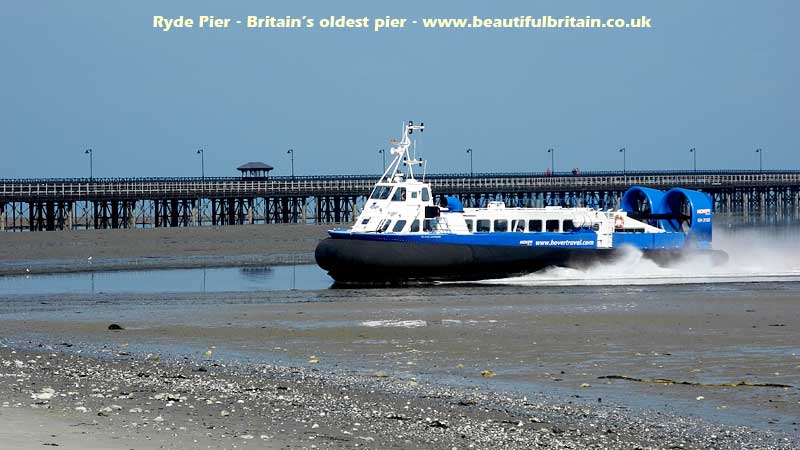 picture of Ryde Pier). It was designed by John Kent of Southampton, is Britain's oldest pier and it paved the way for others, from Dunoon on the Firth of Clyde to Falmouth in Cornwall.
1845The SS Great Britain, (the first iron ship designed by Brunel), sailed from
Liverpool on her maiden voyage. She is now restored and can be viewed at the Great Western Dockyard in Bristol. See  picture.
1858Lionel Rothschild took his seat in the House of Commons to become Britain's
first Jewish member of Parliament.
1890From the roof of the General Post Office in Aldersgate, Marconi
made the first public transmission of wireless (radio) signals.
1895The birth, at Bartley Green - Birmingham, of Jane 'Jinny' Bunford, the tallest person in English medical history, who measured 2.41m. (7ft. 11in.) at the time of her death, aged 26. She was also the tallest person in the world during her lifetime, a record that stood for the next sixty years.
1943Mick Jagger, British rock singer with the Rolling Stones, was born.
1943World War II: The Allies mounted one of the largest raids of the war – sending
more than 1,000 aircraft to bomb the German industrial city of Hamburg. An
estimated 60,000 people were killed.
1945Winston Churchill resigned as Britain's prime minister after his Conservatives
were defeated by the Labour Party in a landslide victory. Clement Attlee became
Prime Minister. He said: 'Labour can deliver the goods.'
1958In Britain, debutantes were presented at the Royal Court for the last
time.
1983A mother of 10 failed to prevent doctors prescribing contraception to
under 16s without parental consent.
198956-year-old Leslie Merry was knocked off his feet, a rib broken and his
spleen ruptured, by a turnip thrown from a passing car in east London. He finally
died of respiratory failure brought on by the accident.
1990It was announced that the Fraud Squad would investigate the National
Union of Mineworkers' accounts over Soviet miners' untraced donations.
2001Prime Minister Tony Blair was greeted by dozens of angry farmers in crisis-torn
Cumbria on a visit to help boost the region's struggling tourist industry following
the foot and mouth crisis.
2007Shambo, a black Friesian bull living in the Hindu Skanda Vale Temple near Llanpumsaint in Wales, was slaughtered due to a bovine tuberculosis infection. He had been adopted by the local Hindu community as a sacred animal and the slaughtering caused widespread controversy.
2013The former BBC broadcaster Stuart Hall's 15-month sentence for a series of indecent assaults was doubled by the Court of Appeal, increasing the term to 30 months. In June 2013, Hall, of Wilmslow, Cheshire, had admitted 14 counts against girls aged from nine to 17 between 1967 and 1985.