
On This Day - 2nd July
1492 The birth, in Richmond Palace, of Elizabeth Tudor, 2nd daughter and 4th child of Henry VII and Elizabeth of York. She died at the young age of 3 years and 2 months, the first of four of Henry and Elizabeth's children to die prematurely.
1489Thomas Cranmer, a leader of the
English Reformation and Archbishop of Canterbury was born. He was
Archbishop during the reigns of Henry VIII, Edward VI and, for a short
time, Mary I. He helped build a favourable case for Henry's divorce from
Catherine of Aragon and, along with Thomas Cromwell, he supported the
principle of Royal Supremacy, in which the king was considered sovereign
over the Church within his realm.
1644English Civil War: The Battle
of Marston Moor at Long Marston, North Yorkshire - (see the 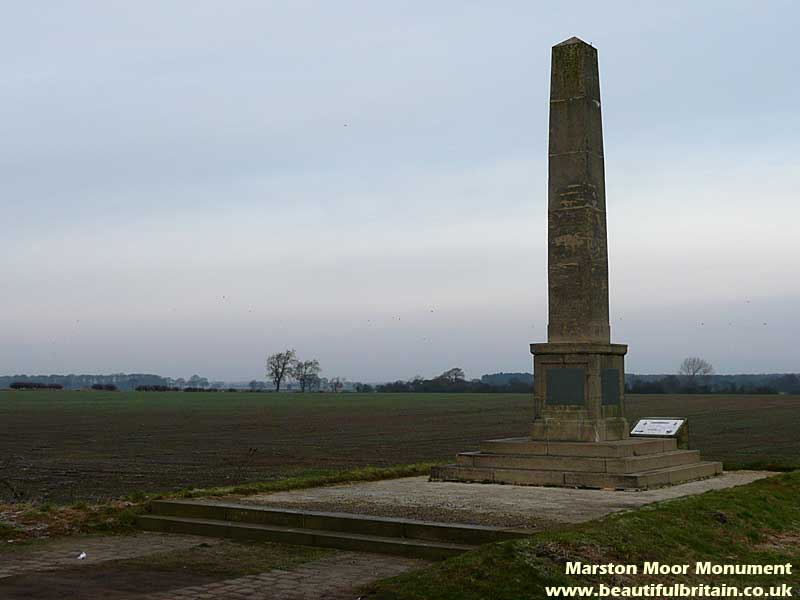 picture of the Marston
Moor Monument and (a
picture of the Marston
Moor Monument and (a  close up picture).
Marston Moor was the first victory of the war for the Parliamentary forces,
with Cromwell's Roundhead Army defeating the Royalist Cavaliers, commanded
by Prince Rupert. After their defeat, the Royalists effectively abandoned
the North of England. The loss of the North was to prove a fatal handicap
the following year, when they tried unsuccessfully to link up with the
Scottish Royalists under Montrose.
close up picture).
Marston Moor was the first victory of the war for the Parliamentary forces,
with Cromwell's Roundhead Army defeating the Royalist Cavaliers, commanded
by Prince Rupert. After their defeat, the Royalists effectively abandoned
the North of England. The loss of the North was to prove a fatal handicap
the following year, when they tried unsuccessfully to link up with the
Scottish Royalists under Montrose.
1698Devon born Thomas Savery
patented the first steam engine. He described it as a ''A new invention for
raiseing of water and occasioning motion to all sorts of mill work by the
impellent force of fire, which will be of great use and advantage for
drayning mines, serveing townes with water, and for the working of all
sorts of mills where they have not the benefitt of water nor constant
windes."
1819The first Factory Act was
passed in Britain. This banned the employment of children younger than 9
from working in textile factories, whilst those under 16 were allowed to
work for 'only' 12 hours a day!
1850 The death of Robert Peel. He served twice as Prime Minister (1834–1835 and 1841–1846) and created the modern police force, leading to a new type of officer known in tribute to him as 'bobbies' or 'peelers'. This statue of Robert Peel (see 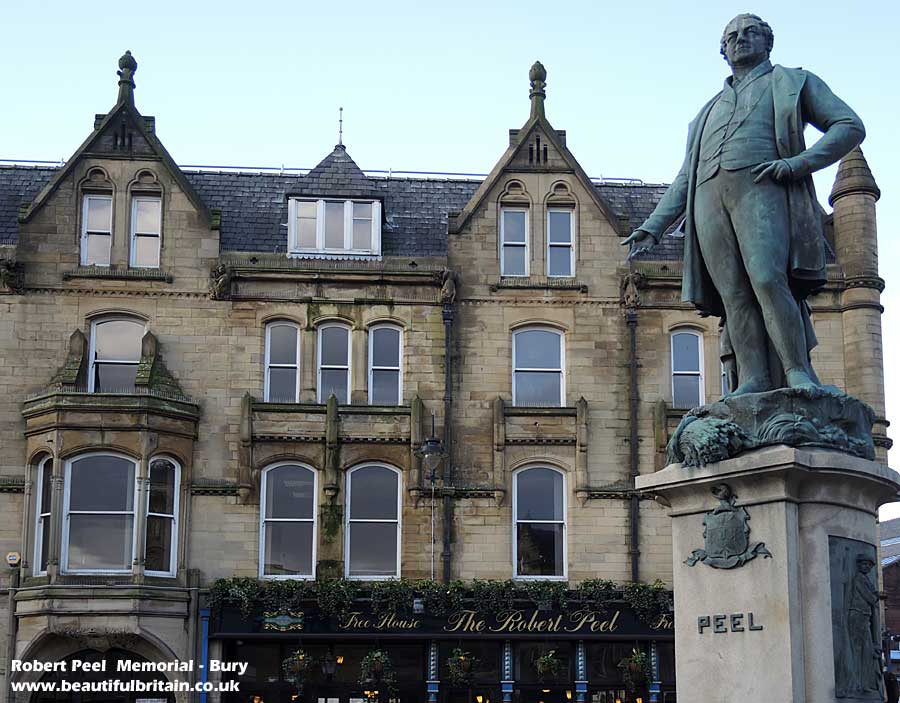 picture) is in Bury, the town of his birth.
1865At a revivalist meeting at
Whitechapel, London, William Booth formed the Salvation Army. Early-day Salvationists started wearing uniform (see 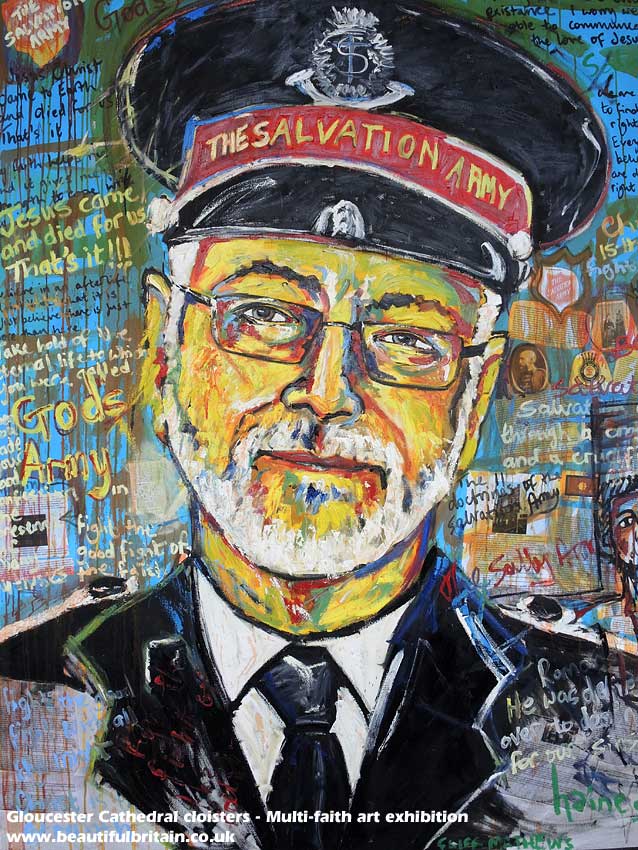 picture) as a natural consequence of the 'army' adopting a military character.
1928 The Representation of the People (Equal Franchise) Act, widened suffrage by giving women electoral equality with men. It gave the vote to all women over 21 years old, regardless of property ownership. Emmeline Pankhurst's house on 62 Nelson Street, Manchester (see  picture), was the birthplace of the Suffragette movement and is now the Pankhurst Centre (see plaque -
 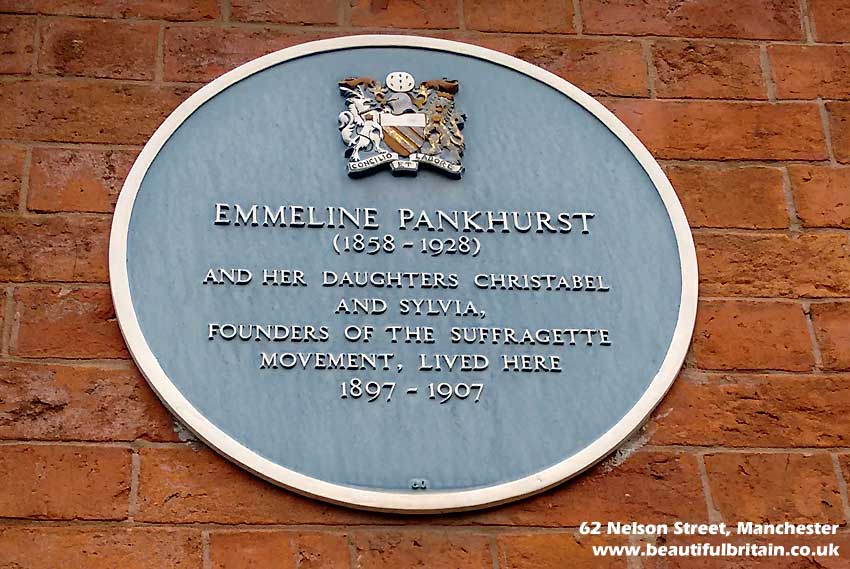 picture)
1940Kenneth Clarke, British
politician was born.
1940World War II: Adolf Hitler
ordered German military commanders to draw up plans for the invasion of
England.
1948Champion English golfer Henry
Cotton won the British Open Golf Championship for the third time.
1973The birth, in Bolton, of
comedian Peter Kay. He has sold over ten million DVDs, more than any other
comedian.
1985The ordination of women as
deacons was approved by the General Synod
1987Moors murderer Ian Brady
offered to assist police searches of Saddleworth Moor for the first time
since his conviction.
1996Weather experts predicted that
global warming would have the effect of moving Britain 100 miles south in
the next 25 years, bringing summer droughts and winter rainstorms.
1997Six IRA terrorists who plotted
to blow up electricity supply stations in the Home Counties were each
jailed for 35 years.
1999The Scottish Parliament was
officially opened by Queen Elizabeth II on the day that legislative powers
were officially transferred from the old Scottish Office in London to the
newly devolved Scottish Executive in Edinburgh.
2001Barry George was sentenced to
life imprisonment for the murder of television presenter Jill Dando. He was
released in 2008 after doubt was cast on the reliability of gunshot residue
evidence.
2005The world's biggest music stars
united in Live8 concerts around the globe to press political leaders to
tackle poverty in Africa.
2012Meteorological Office figures
showed that June 2012 had been the wettest since records began in 1910,
with double the average amount of rain in the UK. It was also the dullest
June on record and the coolest since 1991, with average temperatures of
12.3 degrees C.
2013HM Revenue and Customs was
urged to show "more urgency" in how it dealt with VAT fraud and
tax losses arising out of online trading, after a National Audit Office
report found that £32bn of tax was uncollected in 2010, including an
estimated £9.6bn in VAT.
2014Researchers from Cambridge and
Warwick universities, who had been studying the spread of bovine TB over
the past 15 years found that infected cows brought to a farm were the most
likely cause of the disease. They said that 10 per cent of farms were
acting as 'super-spreaders' and that badgers were not to blame for most
cases of tuberculosis in cattle.
2018British divers, John Volanthen, (an IT consultant based in Bristol) and Rick Stanton, (a former Midlands fire fighter), discovered 12 young Thai footballers and their coach, after nine days trapped in caves in northern Thailand. More than 1,000 people were involved in the global operation. All 13 were rescued after 17 days underground. It was the most challenging underground rescue in history.