
On This Day - 18th June
1429 French forces under the
leadership of Joan of Arc defeated the main English army under Sir John
Fastolf at the Battle of Patay (slightly north of Orléans, France).
The event turned the tide of the Hundred Years' War.
French forces under the
leadership of Joan of Arc defeated the main English army under Sir John
Fastolf at the Battle of Patay (slightly north of Orléans, France).
The event turned the tide of the Hundred Years' War.
1583The first Life Insurance policy
was sold in London, and when a claim was eventually made, it was
disputed.
1633Charles I was crowned King of
Scotland, at Holyrood, Edinburgh. (see 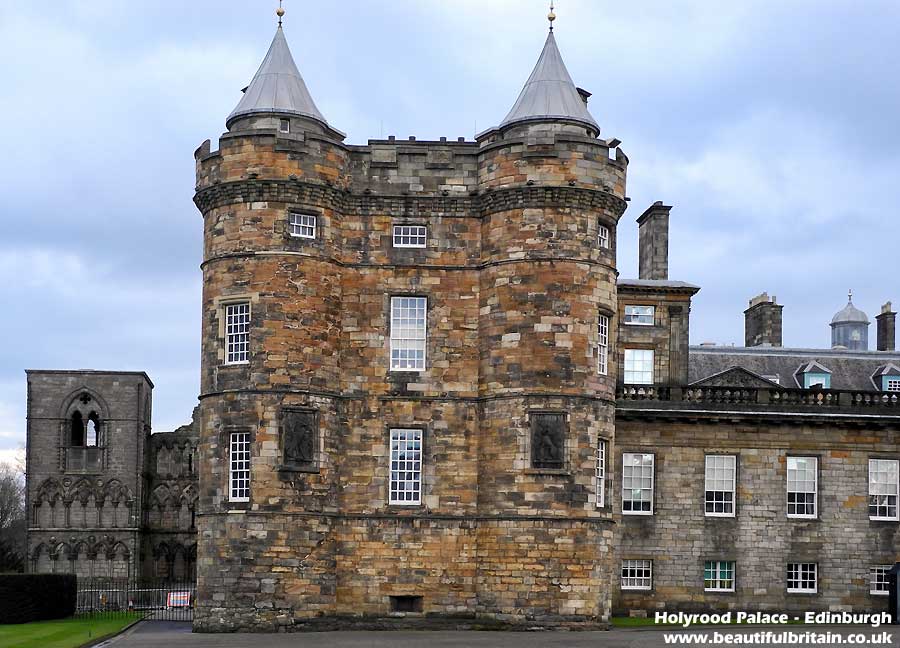 picture)
1767The navigator Samuel Wallis
sighted Tahiti and is considered the first European to reach the
island.
1769The birth of Viscount
Castlereagh, 2nd Marquis of Londonderry, a British statesman born in
Ireland who, as foreign secretary to Lord Liverpool, organized the
coalition against Napoleon.
1815The Battle of Waterloo:-
Napoleon Bonaparte suffered defeat at the hands of the Duke of Wellington,
bringing an end to the Napoleonic era of European history. Waterloo Bridge,
at Betws-y-Coed (see  picture) was built by the civil engineer Thomas Telford. It was constructed
in 1815, the year of the Battle of Waterloo and was only the seventh such
bridge to be built.
picture) was built by the civil engineer Thomas Telford. It was constructed
in 1815, the year of the Battle of Waterloo and was only the seventh such
bridge to be built.
1817Waterloo Bridge across the
River Thames was opened. Originally it was called Strand Bridge but was
re-named in honour of the British victory at Waterloo in 1815.
1822London unveiled its first nude
statue - a bronze figure of Achilles in Hyde Park by sculptor Sir Richard
Westmacott. The statue later acquired a discreet fig leaf.
1858Charles Darwin received a paper
from Alfred Russel Wallace that included almost identical conclusions about
evolution as Darwin's own, prompting Darwin to publish his theory.
1928The keel was laid, at Harland
& Wolff - Belfast, for the biggest ship to date, the 1,000 foot, 60,000
ton Oceanic (III). She was never completed. Her keel was dismantled and the
steel was used in two new, smaller ships, RMS Georgic and RMS Britannic.
Both of these ships entered service in 1930 and were the last liners White
Star ever built.
1928 Amelia Earhart, along with pilot Wilmer Stultz and copilot/mechanic
Louis Gordon flew from Newfoundland (17th June) landing at Pwll near Burry
Port, South Wales on 18th June, thus becoming the first woman to fly across
the Atlantic Ocean. See  picture of the memorial at Burry Port and
  close up of the plaque. In 1932 she became the first woman to fly
solo nonstop across the Atlantic, flying from Newfoundland to Culmore in
Northern Ireland.
close up of the plaque. In 1932 she became the first woman to fly
solo nonstop across the Atlantic, flying from Newfoundland to Culmore in
Northern Ireland.
1935Germany signed a treaty with
Britain limiting the size of the German fleet to 35 percent that of the
Royal Navy.
1945William Joyce (known as Lord
Haw-Haw) was charged with treason for his pro-German propaganda
broadcasting during World War II, using the English language radio
programme Germany Calling. He was hanged at Wandsworth Prison on 3rd
January 1946.
1963Henry Cooper knocked Cassius
Clay (Muhammad Ali) to the floor in round four at Wembley Stadium, London,
but by the sixth, with Cooper badly cut, the fight was stopped and Clay
remained world heavyweight boxing champion.
1965The government announced it
would introduce a blood alcohol limit for drivers, with penalties for those
caught above it.
1972A flight from London Heathrow
to Brussels crashed minutes after take-off killing all 118 people on
board.
1975The first North Sea Oil was
pumped ashore in Britain.
1984The 'Battle of Orgreave'. It was the most violent day of the year-long miners' strike and one of the most violent clashes in British industrial history. The National Union of Mineworkers deployed 5,000 pickets from across the UK to stop lorry loads of coke leaving Orgreave coking plant for the British Steel Corporation's works in Scunthorpe. The number of police officers (6,000 from 18 different forces) was unprecedented in an industrial dispute, as was the use of dogs, horses and riot gear. 71 pickets were charged with riot and 24 with violent disorder. The trials collapsed when the evidence given by the police was deemed 'unreliable'. News footage of the confrontation was edited and broadcast out of chronological sequence, showing pickets throwing stones at the police and the police subsequently carrying out a mounted charge, when the reverse was true.
2000Jamie Andrew, aged 30 years,
became the first quadruple amputee to scale Ben Nevis when he reached the
snow-covered peak after a climb of 6½ hours. He had lost his hands
and feet from severe frostbite after being stranded in the Alps in a fierce
blizzard in 1999.
2012It was announced that 55 year
old Mick Philpott and his wife Mairead (31) whose six children were killed
in a house fire in Allenton, Derby on 11th May would go on trial for their
murder.
2016 Tim Peake, the first British ESA (European Space Agency) astronaut and the seventh UK-born person in space, returned to earth after his 186 day Principia mission working on the International Space Station. The Soyuz TMA-19M descent module (see  picture) was on display at York Railway Museum from 17th January until 8th March 2018.
2020 The death, aged 103, of Dame Vera Lynn. She was known as "The Forces' Sweetheart" and her songs helped raise morale in World War Two. Ahead of the 75th anniversary of VE Day in May 2020, Dame Vera spoke about the bravery and sacrifice that characterised the wartime nation and in the same month she became the oldest artist to get a top 40 album in the UK when her Greatest Hits album re-entered the charts at number 30. One of her best-known songs, We'll Meet Again, was referenced by the Queen earlier in 2020, during a speech to Britons, separated from families and friends during the coronavirus lockdown. Dame Vera was also remembered for her songs The White Cliffs Of Dover, There'll Always Be An England, I'll Be Seeing You, Wishing and If Only I Had Wings.