
On This Day - 14th March
1757 British admiral John Byng was court-martialled and executed by firing
squad on board HMS Monarch at Plymouth, for "failing to do his utmost" to relieve Minorca
from the French fleet following the Battle of Minorca. In practice, his ships badly needed repair and he was relieved of his command before he could see to his ships or secure the extra forces he required.
British admiral John Byng was court-martialled and executed by firing
squad on board HMS Monarch at Plymouth, for "failing to do his utmost" to relieve Minorca
from the French fleet following the Battle of Minorca. In practice, his ships badly needed repair and he was relieved of his command before he could see to his ships or secure the extra forces he required.
1805Master Betty (William Betty) played Hamlet on the London stage, aged
just 14. He was such a success that the House of Commons was adjourned to enable
members to watch his performance. His success was short-lived and, not long
afterwards, he was hissed off the stage.
1864English explorer Samuel Baker was the first European to see the lake
he named Lake Albert after the recently deceased Prince Albert, consort of Queen Victoria.
1873The Insurance Institute of Manchester was born, the first insurance institute in the world.
1885The Mikado, a light opera by W.S. Gilbert and Arthur Sullivan, had its first public performance in London.
1891HMTS Monarch laid a telephone cable along the English Channel bed to prepare for the first telephone links across the Channel. Monarch was launched in 1884, was the first cable ship designed specifically for the GPO and was fitted with three cable tanks, two forward and one aft.
1915World War I: Cornered off the coast of Chile by the Royal Navy after fleeing the Battle of the Falkland Islands, the German light cruiser SMS Dresden was abandoned and scuttled by her crew.
1930A proposed tunnel linking England and France was approved by the Channel
Tunnel Committee.
1945The 617 Dambuster Squadron of the RAF dropped the heaviest bomb of the
war (the 22,000-pound "Grand Slam") on the Bielefeld railway viaduct
in Germany. Although known officially as the Bomb, Medium Capacity, 22,000pound, it was nicknamed 'Ten Ton Tess'.The bomb was designed by Barnes Wallis, who also designed the earlier 'bouncing bomb'. Bielefeld is now twinned with many European towns including Enniskillen in Northern Ireland and Rochdale in Lancashire.
1960The Government announced plans for a Thames Barrier to protect London
from flooding.
1960Jodrell Bank's radio telescope in Cheshire (see 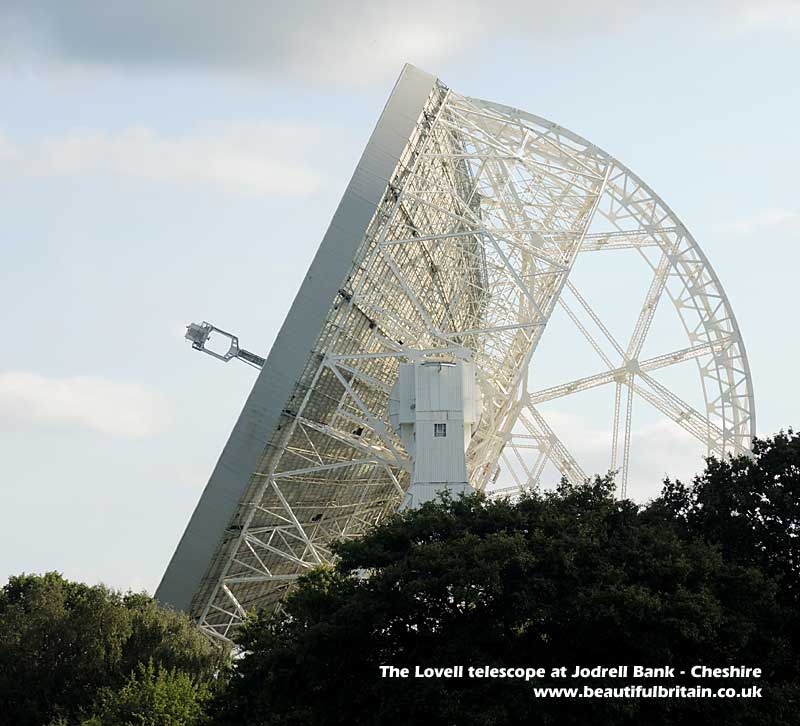 picture.) set a new record, making contact
with the American Pioneer V satellite at a distance of 407,000 miles. The previous
record was 290,000 miles.
picture.) set a new record, making contact
with the American Pioneer V satellite at a distance of 407,000 miles. The previous
record was 290,000 miles.
1961The New English Bible was published.
1963Gerry and the Pacemakers released their first British single, "How Do You Do It?" a song the Beatles had rejected. Their biggest hit was "You'll Never Walk Alone", from the musical Carousel, which has been the adopted anthem of Liverpool Football Club since the mid 1960s.
1984Sinn Fein president, Gerry Adams, was shot and wounded in an attack in
central Belfast when his car was riddled with bullets.
1991The 'Birmingham Six' were freed from jail after 16 years when their convictions
for the murder of 21 people in two pubs were quashed by the Court of Appeal.
1996Joseph O'Connor, operator of the Devon trawler Pescado, which sank in
1991 with the loss of 6 lives, was jailed for 3 years.
2014The death at the age of 88, of Tony Benn, Labour politician, MP for more than 50 years and former cabinet minister.
2014Thieves who had built a 50ft (15m) tunnel to a cash machine on Liverpool Road, Eccles, got away with more than £80,000. The complex nature of its structure could have taken months to excavate and echoes a similar raid in Fallowfield Shopping Precinct in January 2012. Police said they were looking for 'people acting suspiciously, possibly covered in soil.'
2015 Britain's biggest ever cruise ship, the 141,000-ton Britannia, (which was officially named by Her Majesty The Queen in Southampton) set off on its maiden voyage; a 14 night cruise around the Mediterranean.
2018 The death, aged 76, of the world renowned physicist Stephen Hawking. At the age of 22 Professor Hawking was given only a few years to live, after being diagnosed with a rare form of motor neurone disease.