
On This Day - 6th May
878 : 6–12 May - The Battle of Edington, a village in Wiltshire. The arrival of a Danish great army in East Anglia in 865 marked the start of a new phase of Viking attacks on Britain. Previously, the Vikings had come to raid and settle around the coast, but this force came to conquer. Only the victory of Alfred the Great against the Viking Guthrum the Old saved Anglo-Saxon independence. Guthrum was forced to withdraw from Wessex and agree to the division of England.
1536Henry VIII ordered that English language Bibles be placed in every church.
1659English Restoration: A faction of the British Army removed Richard Cromwell as Lord Protector of the Commonwealth.
1801Captain Thomas Cochrane (born at Annsfield, near Hamilton, Lanarkshire) captured the 32-gun Spanish frigate El Gamo in his 14 gun ship HMS Speedy.
1840The first postage stamps, the ‘Penny Black’ and two-penny ‘blues’, which were the brainchild of Roland Hill, became valid for postage On This Day.
1910Following the death of King Edward VII, George V acceded to the throne. He celebrated his Silver Jubilee with Queen Mary in 1935. This statue (see 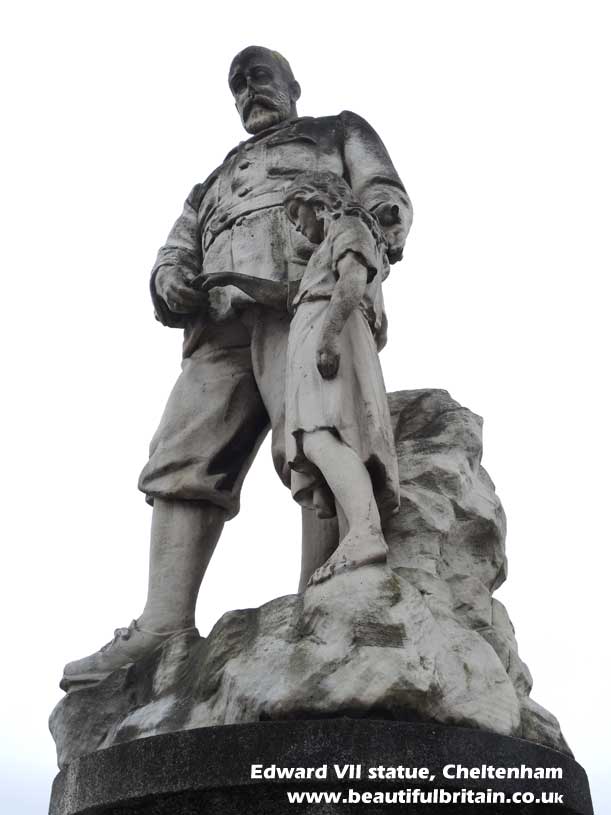 picture), of Edward VII in Cheltenham represents the late King as the Spirit of Peace leading the Spirit of Mischief to the still waters, to form the top of a drinking fountain.
1954Roger Bannister, a 25 year old British medical student, became the first man to run a mile in less than four minute (at the Iffley Road Sports Ground, Oxford). His time was 3 minute 59.4 seconds.
1959Icelandic gunboats fire lived ammunition at British trawlers during a Cod War between Britain and Iceland over fishing rights in the North Sea.
1960Princess Margaret, sister of Queen Elizabeth II, married Anthony Armstrong-Jones at Westminster Abbey in London. It was the first televised royal wedding and was watched by more than 20 million viewers.
1961Tottenham Hotspur, led by Danny Blanchflower, became the first football team in the 20th century (and the third overall) to achieve The Double i.e. FA Cup and League championships, when they beat Leicester City 2-0 to win the Cup at Wembley. Previous FA Double winners were Preston North End 1888-1889 season and Aston Villa 1896-1897 season.
1966At Chester Crown Court, 'Moors murderers' Ian Brady and Myra Hindley were found guilty of torturing and killing several children before burying their bodies on the moors north of Manchester.
1979 These six rock-cut tombs (see 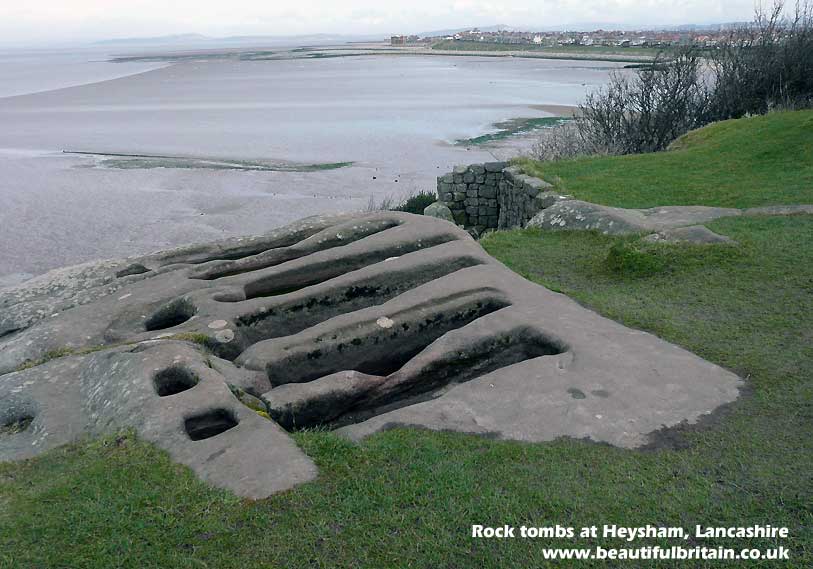 picture) at Heysham in Lancashire became Grade I listed and a Scheduled Ancient Monument. Further excavation in 1993 on land below the stone coffins showed that the site had been occupied about 12,000 years previously.
1988Graeme Hick, Worcestershire's 21 year year old cricketer, scored 405 runs, not out, in a county championship match. It was the biggest innings in England in 93 years.
1990London telephone codes changed to 071 and 081 (replacing 01).
1994The Queen and France's President Francois Mitterrand formally opened the Channel Tunnel during two elaborate ceremonies in France and Britain.
1995The Queen Mother opened (in Hyde Park) three days of VE Day celebrations to mark the 50th anniversary of the ending of World War Two.
1997The Bank of England was given independence from political control. It was the most significant change in its 300 year history.
1999In an historic vote, electors in Scotland and Wales went to the polls to chose their representatives for the newly-devolved Scottish Parliament and Welsh Assembly.
2019The Duchess of Sussex gave birth to a boy, the first child for Prince Harry and his wife Megan. The baby was delivered at 05:26 BST and weighed 7lbs 3oz (3.2kg). At his birth, he became 7th in line to the throne.
2023The coronation of His Majesty The King and Her Majesty The Queen Consort at Westminster Abbey, the 40th reigning monarch to be crowned there since 1066. Coronation timetable - Procession departure from Buckingham Palace at 10:20am to arrive at Westminster Abbey, shortly before 11:00am for the 2 hour service. Procession of King Charles III and Queen Camilla back along Whitehall and The Mall, to Buckingham Palace, a distance of 1.42 miles. In 1953, the route for Queen Elizabeth II's coronation was more than four miles long and it took 45 minutes for the whole procession to pass a single point.