
On This Day - 26th May
604 St. Augustine, the first archbishop of Canterbury died.
735The death of Bede, an English monk and an author and scholar. He was one of the greatest teachers and writers of his age and his most famous work, Ecclesiastical History of the English People, gained him the title "The Father of English History".
1670Charles II and Louis XIV signed a secret treaty in Dover, ending hostilities between England and France.
1733John Kay, assistant to Richard Arkwright, patented the 'Flying Shuttle' to operate on Arkwright's cotton spinning frame. See 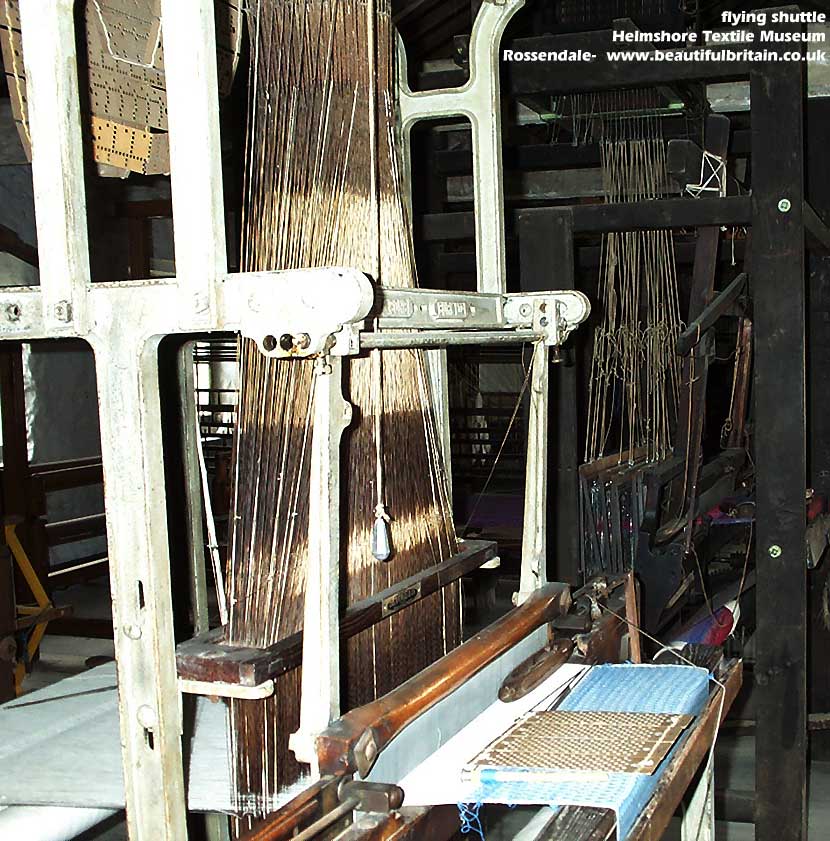 picture at Helmshore Textile Museum in Rossendale, Lancashire. Kay was born at Walmersley, Bury and there is this memorial to him (see
 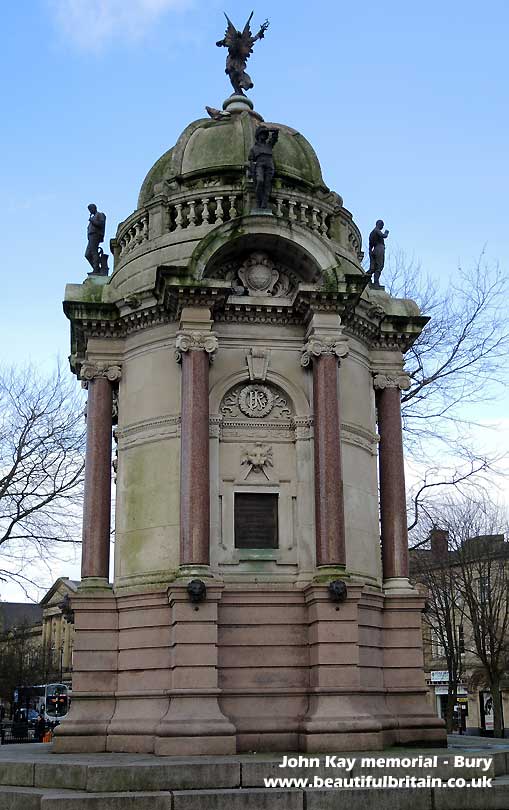 picture) in Bury town centre.
1798Income Tax was introduced into Britain - a 10% tax on all incomes over £200 a year.
1868In the last public execution in England, Irish terrorist Michael Barrett was hanged outside Newgate Prison for causing an explosion in London which left 13 dead.
1897Dracula, a novel by Irish author Bram Stoker was published. The town of Whitby (see this page  ) of the Beautiful Britain website) has associations with Bram Stoker, as he based much of his Dracula novel here whilst staying in Whitby in 1890.
1904The birth, in Wigan, of George Formby, English singer and comedian. He was famous for his comic songs, full of double entendre, to his own accompaniment on the banjo ukulele.
1913Emily Duncan became Britain's first woman magistrate.
1913The birth of Peter Cushing, known for his many appearances in Hammer Films, in which he played the distinguished-looking but sinister scientist Baron Frankenstein and the vampire hunter Dr. Van Helsing.
1936In the House of Commons of Northern Ireland, Tommy Henderson began speaking on the Appropriation Bill, a government measure which applied spending to each department and service. By the time he sat down in the early hours of the following morning, he had spoken for an incredible 10 hours. At that point it was the longest speech in any British legislature.
1940At 18:57 the signal was received to start 'Operation Dynamo', the evacuation of the British Expeditionary Force and French troops from Dunkirk's beaches. Besides the efforts of the Royal Navy, 700 small ships were assembled in Sheerness dockyard before making the hazardous crossing to Dunkirk. In total, 338,226 troops were safely returned to England between 27th May and 4th June
1950Long queues appeared at garages and motorists tore their ration books into confetti after the end to petrol rationing.
1969Beatle John Lennon and his wife Yoko Ono staged a public 'bed in' for world peace - staying in bed for a week in a hotel in Montreal.
1972State-owned travel firm Thomas Cook & Son was sold to a consortium of private businesses headed by the Midland Bank.
1989The BBC broadcast the 10,000th episode of the daily radio serial The Archers.
1998Emperor Akihito of Japan spoke of his "deep sorrow and pain" over the suffering inflicted by his country during World War II, but war veterans felt he did not go far enough and turned their backs on him.
1999Manchester United became the first British club to win the European Cup for 15 years, beating Bayern Munich 2-1 in the final in Barcelona. This gave them the coveted 'treble' - the Premier League, the FA Cup and the European Cup.
2012The seemingly never-ending task of painting the Forth Bridge (see 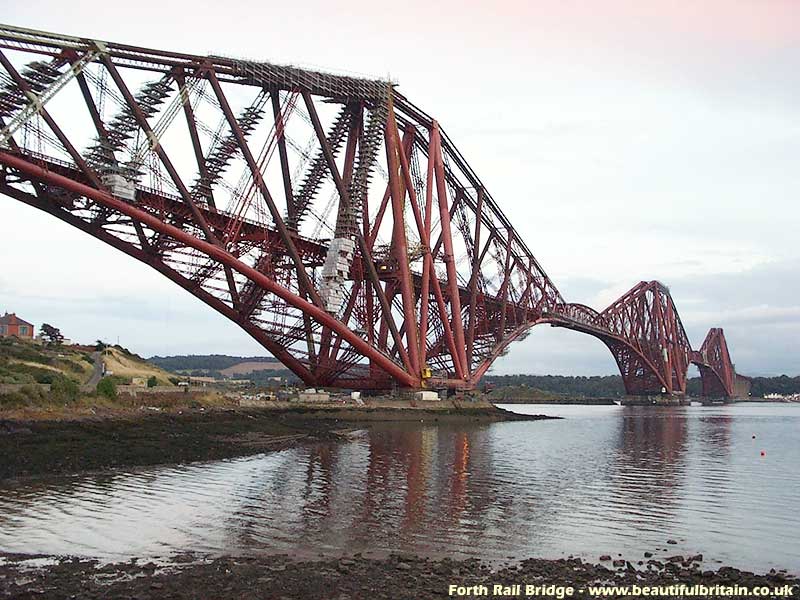 picture) was finally completed, following a 10-year programme of work and 240,000 litres of 'epoxy glass plate paint' that should last for 20 years. More than 1,500 people worked on the bridge during its restoration, with as many as 400 workers on the bridge in a single day at the peak of activity.
2014Liberal Democrat leader Nick Clegg rejected calls for him to stand down, after the party's worst European election result for 25 years. The Liberal Democrats lost all but one of their 12 MEPs.