
On This Day - 3rd May
1497 A rising broke out in Cornwall, provoked by taxation. James Tutchet led an army of 15,000 from Taunton through the southern counties to attack London.
1788The first daily evening newspaper, the Star and Evening Advertiser, was published in London.
1830The Canterbury and Whitstable Railway (Kent) was opened. Sometimes referred to colloquially as the Crab and Winkle Line, it was the first steam hauled passenger railway to issue season tickets. It used cable haulage by stationary steam engines over much of its length, with steam locomotives restricted to the level stretch.
1841New Zealand was declared a British colony.
1844Richard D'Oyly Carte, producer of Gilbert and Sullivan operas, was born.
1876 The death of the doctor and philanthropist Samuel Taylor Chadwick. He provided funds to enable houses to be built for people living in cellars, fought for better public health provisions such as cleaner water, established the Chadwick Orphanage for girls, improved the Bolton Workhouse and in 1863 he set up a charity to help European refugees. Sadly, both his own children died at a young age. This staue of Chadwick (see 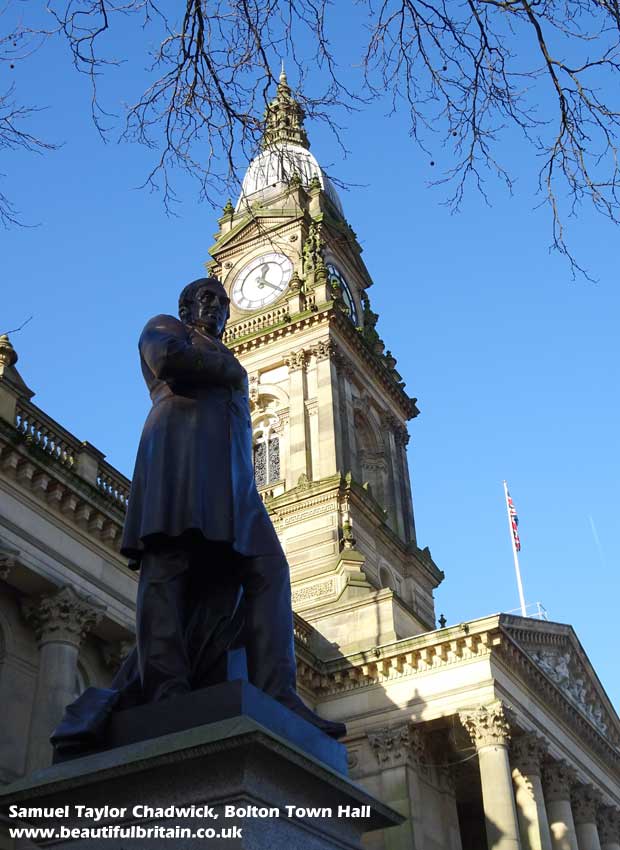 picture) is outside Bolton Town Hall in Greater Manchester.
1926Britain's first General Strike, in support of the miners started 'On This Day'. It ended on 12th May.
1934Science fiction writer H.G.Wells predicted there would be a world war before 1940.
1934The birth of boxer Henry Cooper. He was known for the effectiveness of his left hook, "Enry's 'Ammer", and his knockdown of the young Muhammad Ali. Cooper, who died on 1st May 2011, held the British, Commonwealth and European heavyweight titles several times throughout his career and is the only boxer to have been awarded a knighthood.
1951King George VI opened the Festival of Britain. It was built on an old bomb site near Waterloo Station in London.
1952Newcastle United became the first team since 1891 to win two FA Cups in succession by beating Arsenal 1-0.
1956Granada TV broadcast for the first time at 7.30 p.m. With the ending of the BBC's monopoly on broadcasting, viewers saw their first television advertising and four days later Granada did the first sports outside broadcast.
1968The first heart transplant in Britain was carried out at the National Heart Hospital in Marylebone, London. It was undertaken on an unnamed 45-year-old man.
1999The body of missing English climber George Mallory was found near the summit of Mount Everest. He had gone missing more than 60 years earlier.
2000The London Stock Exchange and Germany's Deutsche Boerse merged, creating the world's second largest stock market.
2000Two Libyan men pleaded not guilty to charges that they were involved in the Lockerbie bombing of PanAm flight 103 in 1988.
2007Three year old Madeleine McCann went missing from her family's holiday apartment at the Ocean Club, in Praia da Luz, Portugal. To date, she has not been found.
2008Boris Johnson won the race to become Mayor of London - ending Ken Livingstone's eight year reign at City Hall.
2014An ornate golden crown that went onto the coffin of Richard III when he was re-buried in Leicester Cathedral (26th March 2015) was displayed at Tewkesbury Abbey. The crown 'gold with sapphires, diamonds, garnets, studded with jewels' was commissioned and paid for by the historian Dr John Ashdown-Hill who helped identify the king's remains.